hidden
|
Mordvinov N.S. (1754-1845), Admiral, statesman
MORDVINOV Nikolay Semenovich (1754-1845, St. Petersburg), statesman and military figure, economist, admiral (1797), honorary member of Petersburg Academy of Sciences (1826) and Russian Academy (1818). The son of S.I
|
|
|
|
|
hidden
|
Mordvinov S.I. (1701-1777), Admiral
MORDVINOV Semen Ivanovich (1701-1777, St. Petersburg), Admiral (1764). The father of N.S. Mordvinov. Studied in Novgorod and Narva Mathematical Schools, graduated from the Naval Academy in St. Petersburg (1716)
|
|
|
|
|
hidden
|
Morozov A.P. (1907-1987), engineer.
MOROZOV Alexey Petrovich (1907-1987, Leningrad), civil engineer, associate academy member of architecture (1956). Graduated from the Leningrad Institute of Civil Engineering (1934)
|
|
|
|
|
hidden
|
Morozov N.A. (1854-1946), revolutionary, chemist, astronomer
MOROZOV Nikolay Alexandrovich (1854-1946), revolutionary-narodnik, writer, scientist, author of memoirs, honorary member of the Academy of Sciences of the USSR (1932)
|
|
|
|
|
hidden
|
Morskaya Bolshaya Street
MORSKAYA BOLSHAYA STREET (in 1920-93 - Herzen Street, after A.I. Herzen), located from the General Staff Arch to Kryukov Canal. It was constructed in the early 18th century, in Morskaya settlement (hence the name)
|
|
|
|
|
hidden
|
Morskaya Embankment
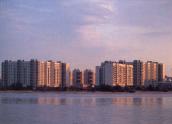
MORSKAYA EMBANKMENT goes along the aggraded shore of the Gulf of Finland from the square in front of the Pribaltiyskaya Hotel to Nalichnaya Street (the name was given in 1972)
|
|
|
|
|
hidden
|
Morskaya Malaya Street
MORSKAYA MALAYA STREET (since 1738 - Bolshaya Lugovaya Street, since the middle of the 18th century until the 1820s - Novaya Isaakievskaya Street, in 1902-93 - Gogolya Street, after N.V. Gogol), between Nevsky Prospect and St. Isaac's Square
|
|
|
|
|
hidden
|
Morskie Dubki, Park (Lisy Nos)
MORSKIE DUBKI is a park at the West end of the village Lisy Nos. It stretches in a strip near the shore of the Gulf of Finland. Its length is approximately 500 metres and its width ranges from 100 to 250 metres
|
|
|
|
|
hidden
|
Morskoy Canal
MORSKOY CANAL (the Naval Canal) was constructed along shallow waters of Neva Bay between Gutuyevsky and Kanonersky Islands in 1874-85. The Canal has materially changed the islands' shape
|
|
|
|
|
hidden
|
Moscow Life Guards Regiment
MOSCOW LIFE GUARDS REGIMENT, infantry guards regiment, formed in 1811 out of the 1st Life Guards Battalion of Preobrazhensky Regiment as the Life-Guards Litovsky (Lithuanian) Regiment, in 1817 named the Moscow (Moskovsky) Life-guards Regiment
|
|
|
|
|
hidden
|
Moscow Triumphal Arch
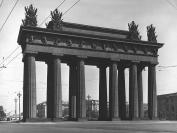
MOSCOW TRIUMPHAL ARCH built in 1834-38, designed by architect V.P. Stasov, stands on the intersection of Moskovsky Avenue and Ligovsky Avenue in commemoration of the Russian military victories in the Russo-Turkish War of 1828-29
|
|
|
|
|
hidden
|
Moscow, Hotel
MOSCOW HOTEL, (2 Alexander Nevsky Square). Built in 1974-77 (architects D.S. Goldgor, V.N. Scherbin, L.K. Varshavskaya, engineer E.V. Golubev). The seven-floor building has 777 rooms (for a total of 1,415 guests), 5 restaurants, bars on each floor
|
|
|
|
|
hidden
|
Moshkov Lane
MOSHKOV LANE named Zaporozhsky Lane after a Ukrainian city in 1952-89, between Dvortsovaya Embankment and Moika River Embankment. It was laid in the first quarter of the 18th century and named after houseowner and Master of the Household P. I
|
|
|
|
|
hidden
|
Mosin S.I., (1849-1902), Designer
MOSIN Sergey Ivanovich (1849-1902) was a designer of arms, Major-General (1900). He graduated from Mikhailovskaya Artillery Academy (1875). Mosin headed the Sestroretsk Arms Plant (1894-1902)
|
|
|
|
|
hidden
|
Moskovskaya Side
MOSKOVSKAYA Side, the 18th century name of the territory on the left bank of the Neva River to the east and south-east from the Fontanka River, that was populated with labourers, brought from Moscow in the early 18th century (hence the name)
|
|
|
|
|
hidden
|
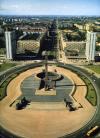
Moskovskaya Square
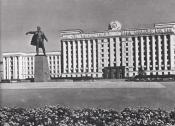
MOSKOVSKAYA SQUARE, in the south part of Moskovsky Avenue, at its intersection with Leninsky Avenue and Tipanova Street. Occupying the territory of 13 hectares, it is recognised as the largest square in St. Petersburg
|
|
|
|
|
hidden
|
Moskovskaya Zastava
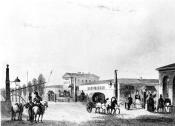
MOSKOVSKAYA ZASTAVA, the historical name of the north part of present-day Moskovsky District. The name originates from the post that existed at the intersection of Moscow road and Ligovsky Canal
|
|
|
|
|
hidden
|
Moskovskoe Freeway
MOSKOVSKOE FREEWAY, between Pobedy Square and line of the Circular Railway, continues Moskovsky Avenue. It appeared in the first quarter of the 18th century as the road to Sarskaya Myza (Tsarskoe Selo) and further on to Novgorod and Moscow (in the
|
|
|
|
|
hidden
|
Moskovsky Avenue
MOSKOVSKY AVENUE (in 1918-50 - Mezhdunarodny Avenue, in 1950-56 - Stalina Avenue, after I.V. Stalin), from Sennaya Square to Pobedy Square, one of the main thoroughfares of St
|
|
|
|
|
hidden
|
Moskovsky District
MOSKOVSKY DISTRICT is an administrative territorial unit of St. Petersburg. (Its territory administration is located at 129 Moskovsky Avenue) It was founded in 1919, and its present-day borders were established in 1965
|
|
|
|
|
hidden
|
Moskovsky Park of Victory
MOSKOVSKY PARK OF VICTORY (188 Moskovsky Avenue) is located in the south of St. Petersburg, between Moskovsky Avenue and Gagarin Avenue. A project of a district Park of Culture and Recreation
|
|
|
|
|
hidden
|
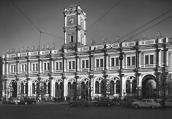
Moskovsky Railway Station
MOSKOVSKY RAILWAY STATION (in 1855-1924 Nikolaevsky Railway Station) (located at 2 Vosstaniya Square), was built in 1844-51 by architect K.A. Ton. A commemorative plaque in his memory appears on the facade
|
|
|
|
|
hidden
|
Moskvin A. N. (1901-1961), cameraman
MOSKVIN Andrey Nikolaevich (1901, Tsarskoe Selo - 1961, Leningrad), cameraman, Honoured Art Worker of the Russian Soviet Federative Socialist Republic (1935). Studied at the Institute of Railway Engineering. Worked with directors G. M
|
|
|
|
|
hidden
|
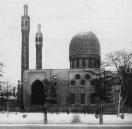
Mosque
MOSQUE, Central Mosque, located at 7 Kronverksky Avenue. An architectural monument, constructed in 1910-13 on a lot near Troitskaya Square bought in 1907 by the Emir of Bukhara. Designed by architects N. V. Vasilyev, S. S. Krichinsky and A. I
|
|
|
|
|
hidden
|
Mozhaysky Military Space Engineering Academy
MOZHAYSKY MILITARY SPACE ENGINEERING ACADEMY (MSEA) (13 Zhdanovskaya Embankment), higher military educational institution. It prepares engineers and scientists
|
|
|
|
|
hidden
|
Mozhaysky А.F. (1825-1890), constructor
MOZHAYSKY Alexander Fedorovich (1825-1890, St. Petersburg), inventor, creator of an aircraft heavier than the air, Rear-Admiral. (1886). Graduated from the Naval Cadet School (1841)
|
|
|
|
|
hidden
|
Mozhaysky, settlement
MOZHAYSKY, a former urban settlement, known as Duderhof until 1950; incorporated in 1973 into the Krasnoselsky District of Leningrad. Located 30 kilometres southwest of the city centre
|
|
|
|
|
hidden
|
Mravina E.K. (1864-1914), singer
MRAVINA (the stage name; nee Mravinskaya, married name Koribut-Dashkevich) Evgenia Konstantinovna (1864, St. Petersburg - 1914), opera singer (lyric coloratura soprano), chamber singer. Took singing lessons from I.P
|
|
|
|
|
hidden
|
Mravinsky Е.А., (1903-1988), conductor
MRAVINSKY Evgeny Alexandrovich (1903 - 1988, Leningrad), conductor, people's artist of the USSR (1954) and Hero of Socialist Labour (1973). A student of the Second Gymnasium, Petersburg University, and Academic Chapel
|
|
|
|
|
hidden
|
Muessar's Mondays
MUESSAR'S MONDAYS (until 1912 The Society for Supporting Artists' Families), a charitable society of artists, patrons of the arts and arts lovers. It was established in 1881 on the initiative of the Privy Counsellor E.I. Muessar
|
|
|
|
|