|
|
hidden
|
Chancellery, His Imperial Majesty's Personal
CHANCELLERY, HIS IMPERIAL MAJESTY'S Personal, a supreme public institution. The Chancellery consisted of several divisions, which were established during the first half of the 19th century to carry out the Sovereign's personal supervision over
|
|
|
|
|
hidden
|
Chapygin A.P. (1870-1937), writer
CHAPYGIN Alexey Pavlovich (1870-1937, Leningrad), writer. Lived in St. Petersburg from 1883, worked as an apprentice in painting shops. He had little formal education
|
|
|
|
|
hidden
|
Charity (entry)
CHARITY, philanthropic activities, aimed at extending aid to the needy and carried out by social and church organisations, state establishments, as well as by private persons for religious, moral and humane reasons (public and private charity)
|
|
|
|
|
hidden
|
Charlemagne I. I. (1782-1861), architect
CHARLEMAGNE Iosif Iosifovich (1782 - 1861, St. Petersburg), architect, graphic artist, privy counsellor (1861). Born to a family of French origin, the brother of L.I. Charlemagne. He graduated from the Academy of Fine Arts (1803)
|
|
|
|
|
hidden
|
Charlemagne L. I. (1784-1845), architect
CHARLEMAGNE Ludovik Iosifovich (1784 - 1845, St. Petersburg), architect, master of the Empire style. I. I. Charlemagne's brother. Upon graduating the Academy of Fine Arts (1806) worked as the assistant of the architects L. Rusca and А.А. Mikhailov
|
|
|
|
|
hidden
|
Charter Court
CHARTER COURT (28 Tchaikovskogo Street), the organ of judicial power, upholding the Charter of St. Petersburg and ensuring supremity of law. The Court took office on September 20, 2000 pursuant to the Law of St. Petersburg dated June 5, 2000
|
|
|
|
|
hidden
|
Charter of St. Petersburg
CHARTER OF ST. PETERSBURG, the main normative document of the city adopted by the Legislative Assembly of St. Petersburg on January 14, 1998, signed by the Governor on February 28, 1998. It is comprised of 12 chapters and 80 articles
|
|
|
|
|
hidden
|
Charushin E.I., (1901-1965), the artist
CHARUSHIN Evgeny Ivanovich (1901-1965, Leningrad), the graphic artist, writer, honorable art figure of the Russian Soviet Federal Socialist Republic (1945). He studied at the Academy of Arts (1922-26) under the supervision of A. I. Savinov and A. A
|
|
|
|
|
hidden
|
Chasseur Life Guards Regiment
CHASSEUR LIFE GUARDS REGIMENT, infantry guards regiment. Formed in 1796 as a battalion, in 1806 deployed into a regiment. Participated in the Napoleonic Wars of 1805, 1806-07, 1812-14, wars with Turkey 1828-29, 1877-78
|
|
|
|
|
hidden
|
Chat Noir, Cabaret
CHAT NOIR (from the French сhat noir - black cat), cabaret (126 Nevsky Prospect; the building was erected in 1883 as a Tenement apartment, architect G. I. Karpov)
|
|
|
|
|
hidden
|
Chaykovsky B.V. (1888-1924), film director
CHAYKOVSKY Boris Vitalyevich (1888-1924, Leningrad), film director, script writer, and teacher. He worked as a film director and script writer at film companies of A. Drankov, A. Taldykin, A. Khanzhonkov, et al. from 1909
|
|
|
|
|
hidden
|
Chaykovsky N.V. (1850-1926), revolutionary, political figure
CHAYKOVSKY Nikolay Vasilievich (1850-1926) was a political figure. On graduating from the 7th St. Petersburg Gymnasium (1868) he studied at the Faculty of Natural History of St. Petersburg University
|
|
|
|
|
hidden
|
Chebyshev P.L., (1821-1894), mathematician
CHEBYSHEV Pafnuty Lvovich (1821-1894, St. Petersburg), mathematician and mechanical engineer, Member of the Petersburg Academy of Sciences from 1859. He graduated from Moscow University with a major in physics and mathematics in 1841. He came to St
|
|
|
|
|
hidden
|
Chekhonin S.V. (1878-1936), artist
CHEKHONIN Sergey Vasilievich (1878-1936), painter and graphic artist. He did his studies at the Drawing School of the Society for the Encouragement of Arts (1896-97) and at Princess M.K. Tenisheva's school under I.E. Repin (1897-1900)
|
|
|
|
|
hidden
|
Chekhov М.А. (1891-1955), actor, director, and teacher
CHEKHOV Mikhail Alexandrovich (1891, St. Petersburg - 1955), actor, teacher, and theatre worker; Honoured Artist of the State Academic Theatres in 1924. Anton Chekhov's nephew
|
|
|
|
|
hidden
|
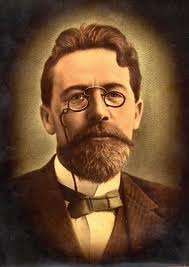
Chekhov, Anton Pavlovich
Anton Pavlovich Chekhov (1860–1904), a writer. Chekhov came into Saint Petersburg more than once since 1885. He mostly stayed at home of A.S. Suvorin, the publisher of the newspaper “The New Time” (6 Ertyelev Lane (now Chekhov Street))
|
|
|
|
|
hidden
|
Chekhova Street
CHEKHOVA STREET, known as Ertelev Lane until 1923, between Zhukovskogo Street and Nekrasova Street. The street was laid in the second half of the 18th century. Its original name was derived from the last name of a house-owner
|
|
|
|
|
hidden
|
Chekushi
CHEKUSHI is an area located in the south-western part of Vasilievsky Island. Its name is known from the first part of the 18th century and is related to "chekushi" or "tokmochi"
|
|
|
|
|
hidden
|
Cheltsov M.P. (1870-1931), Venerable Martyr
CHELTSOV Mikhail Pavlovich (1870-1931, Leningrad), archpriest, religious and public figure. Graduated from Kazan Theological Academy in 1894. From1898 he lived in St
|
|
|
|
|
hidden
|
Cherkasov N.K., (1903-1966), actor
CHERKASOV Nikolay Konstantinovich (1903, St. Petersburg - 1966, Leningrad), actor, People's Artist of the USSR (1947). Graduated from the Leningrad Dramatics School in 1926
|
|
|
|
|
hidden
|
Chernavka, river
CHERNAVKA, a river in the east of St. Petersburg, a tributary to the Okhta River. The length is about two kilometres; width in its lower course is up to 12 metres. The name was caused by the dark colour of the water
|
|
|
|
|
hidden
|
Chernaya Rechka River
CHERNAYA RECHKA, a river in the north-west of St. Petersburg. The name dates back to 1748. The river is a tributary of the Bolshaya Nevka River. Originally it sprang from Lake Dolgoe and flowed into the Bolshaya Nevka from the right
|
|
|
|
|
hidden
|
Chernov D.K., (1839-1921), Metallurgist
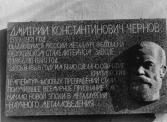
Chernov Dmitry Konstantinovich (1839, St. Petersburg - 1921), scientist of metallurgy. He graduated from St. Petersburg Technological Institute (1858), and later taught there in 1859-68 (26/49 Moskovsky Avenue; commemorative plaque)
|
|
|
|
|
hidden
|
Chernov V. M. (1873-1952), Socialist Revolutionary
CHERNOV Viktor Mikhailovich (1873-1952) was a political figure, sociologist, and publicist. On graduating from Derpt Gymnasium (1892) he entered the Faculty of Law of Moscow University, and participated in revolutionary circles
|
|
|
|
|
hidden
|
Cherny Peredel, revolutionary organizations
CHERNY PEREDEL (Black Repartition), a revolutionary populist organization that came into existence in the summer of 1879 after the split of Zemlya i Volya. Its founders were G.V. Plekhanov, V.I. Zasulich, L.G. Deutsch, P.B. Axelrod, V.N. Ignatov, O
|
|
|
|
|
hidden
|
Cherny Sasha (1880-1932), poet
CHERNY Sasha (real name Alexander Mikhailovich Glikberg) (1880-1932), poet, prose writer, translator, children's writer. He came to St. Petersburg in 1895; he studied at a gymnasia
|
|
|
|
|
hidden
|
Chernyshevskogo Avenue
CHERNYSHEVSKOGO AVENUE, called Voskresensky Avenue until 1923, from Robespierre Embankment to Kirochnaya Street. The avenue was renamed in commemoration of N.G. Chernyshevsky
|
|
|
|
|
hidden
|
Chernyshevsky N. G. (1828-1889), publicist, critic, writer
CHERNYSHEVSKY Nikolay Gavrilovich (1828-1889), publicist, writer, critic. From 1846-64 lived in St. Petersburg (with an interruption from 1851-53). Graduated from the Faculty of History and Philology of Petersburg University (1850)
|
|
|
|
|
hidden
|
Chervyakov E.V. (1899-1942), film director
CHERVYAKOV Evgeny Veniaminovich (1899-1942, Mga, Leningrad Region), film director, actor, script writer. Graduated from the Studio of Dramatic Arts in Ufa in 1918 and the State Film School in Moscow in 1927
|
|
|
|
|
hidden
|
Chesme Church
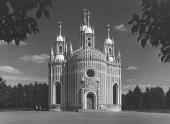
Chesme Church, the Church of the Nativity of St. John the Baptist, located at 12 Lensoveta St. An example of Neo-Gothic architecture, erected in 1777-80 (architect Y.M
|
|
|
|
|
|