The subject index
/
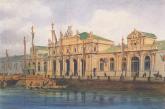
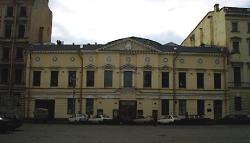
Passage, department store
hidden
|
Association of Artists
ASSOCIATION OF ARTISTS, an artistic union was established by a group of former members of the St. Petersburg Society of Artists in 1904. The Charter was approved in 1906
|
|
|
|
|
hidden
|
Bi-Ba-Bo, Cabaret Theatre
BI-BA-BO, a cabaret theatre, opened in January 1917 in the vault of the Passage (19 Italyanskaya Street). It was established by producer K. A. Mardzhanov, poet N. Y. Agnivtsev and artist F. N
|
|
|
|
|
hidden
|
Commerce (general)
COMMERCE. Favorably located, St. Petersburg has always played a major role in the country’s foreign trade (see Sea Port). The life of the city itself has been mainly supported by home trade, retail trade above all
|
|
|
|
|
hidden
|
Concert Halls (entry)
CONCERT HALLS appeared in St. Petersburg in the late 18th century. Earlier, musicians arranged paid concerts in palaces of grandees, theatres, and taverns. The first documented series of public concerts refers to the concerts given by G
|
|
|
|
|
hidden
|
Corner, Cabaret
CORNER (Ugolok), cabaret theatre, and artistic club. Opened in the building of the Passage (entrance from 19 Italyanskaya Street) in January 1915. It was established by G. P. Makarov. V. N. Davydov, L. Y. Lipkovskaya, E. V. Lopukhova, Y. S
|
|
|
|
|
hidden
|
Davydov V.N., (1849-1925), actor
DAVYDOV Vladimir Nikolaevich (real name Ivan Nikolaevich Gorelov) (1849-1925), actor, pedagogue, People's Artist of the Respublic (1922). In 1866, he graduated from a gymnasium in Tambov
|
|
|
|
|
hidden
|
Gramophone
GRAMOPHONE, the first phonographs appeared in St. Petersburg at the beginning of the 1880s, shortly after they had been invented by T. Edison. At the beginning of the 1890s they were replaced by gramophone records and gramophones
|
|
|
|
|
hidden
|
Granovskaya E.M., (1877-1968), actress
GRANOVSKAYA Elena Mavrikievna (1877-1968, Leningrad), actress, People's Artist of the Russian Soviet Federative Socialist Republic (1944). Graduated from Annenschule (1895)
|
|
|
|
|
hidden
|
Industrial Exhibitions (entry)
INDUSTRIAL EXHIBITIONS, organised by the government from the 1820s, intended to boost the national industry, interior and foreign trade, under the jurisdiction of the Trade and Manufactory Department of the Ministry of Finance
|
|
|
|
|
hidden
|
Italyanskaya Street
ITALYANSKAYA STREET, running from Griboedova Canal to the Fontanka River. Known as Bolshaya Italyanskaya Street from 1871 to 1919, then called Rakova Street until 1991
|
|
|
|
|
hidden
|
Komissarzhevskaya Theatre
KOMISSARZHEVSKAYA THEATRE (19 Italyanskaya Street). Established in 1942 as the City ("Besieged") Theatre, being legitimized as a drama theatre in 1943, named after V.F. Komissarzhevskaya in 1959, and granted academic status in 1994
|
|
|
|
|
hidden
|
Komissarzhevskaya Theatre
KOMISSARZHEVSKAYA THEATRE (also called Drama Theatre under the Directorship of V. F. Komissarzhevskaya, and Drama Theatre of V. F. Komissarzhevskaya), a private theatre founded in 1904 by V.F. Komissarzhevskaya
|
|
|
|
|
hidden
|
Komissarzhevskaya V.F., (1864-1910), actress
KOMISSARZHEVSKAYA Vera Fedorovna (1864, St. Petersburg - 1910), actress. The sister of F.F. Komissarzhevsky. Studied in Moscow under her father, opera singer and pedagogue F.P
|
|
|
|
|
hidden
|
Monakhov N.F., (1875-1936), actor
MONAKHOV Nikolay Fedorovich (1875, St. Petersburg - 1936, Leningrad), actor, People's Artist of Russian Soviet Federative Socialist Republic (1932). Received some education at a school in St
|
|
|
|
|
hidden
|
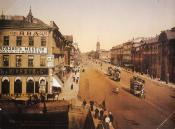
Nevsky Prospect
NEVSKY PROSPECT known as Bolshaya Pershpektivnaya Road or Bolshaya Pershpektiva until 1738, Nevskaya Prospektivaya Street or Nevskaya Perspektiva in 1738-1780s, and 25 October Avenue in 1918-44 so named in memory of the October Revolution of 1917
|
|
|
|
|
hidden
|
New Society of Artists
NEW SOCIETY OF ARTISTS, art association founded in 1903 on the initiative of artist D. N. Kardovsky (chairman) by his pupils I. E. Repin and A. I. Kuindzhi. Intended to support graduates and graduates-to-be of the Academy of Arts
|
|
|
|
|
hidden
|
Prostitution
PROSTITUTION, the rendering of sexual services in return for money. In the 18th to the early 19th century, prostitution in St. Petersburg existed illegally; owners of brothels were foreigners
|
|
|
|
|
hidden
|
Public Halls (entry)
PUBLIC HALLS, a special premise for informal mass events. The first public hall was arranged in banker A.A. Ral's house (On the Moika River Embankment, beside Red Bridge; not preserved)
|
|
|
|
|
hidden
|
Society of Russian Watercolorists
SOCIETY OF RUSSIAN WATERCOLORISTS, named the Circle of Russian Watercolorists till 1887 and the Imperial Society of Russian Watercolorists in 1907-17, art association founded in 1880 on the initiative of artist and teacher E. S
|
|
|
|
|
hidden
|
Treugolnik, creative association
TREUGOLNIK, the artistic psychological group Treugolnik was one of the first unions of Russian avant-garde artists. It was founded on the initiative of Nikolay Kulbin. Its members (M.E. Anders, Avgust Ballier, G.K
|
|
|
|
|
hidden
|
Tsentralny (Central) District
TSENTRALNY (CENTRAL) DISTRICT, an administrative-territorial entity within St. Petersburg, with the territorial administration situated at 176 Nevsky Prospect. The district was set up in 1994, when Smolninsky District
|
|
|
|
|
hidden
|
World of Art, Association
WORLD OF ART, an art association. Begun in the mid-1890s by a circle of students, the main body including graduates of K. I. May's Gymnasium, such as Alexander N. Benois, W. F. Nouvel, and D. V. Filosofov, who were later joined by L. S. Bakst, S. P
|
|
|
|
|