The subject index
/
Sheremetev Palace
hidden
|
Akhmatova A.A. (1889-1966), poet
AKHMATOVA Anna Andreevna (nee Gorenko) (1889-1966), poet, Honorary Doctor of Oxford University (1965). She spent her childhood (until 1905) in Tsarskoe Selo (the corner of Shirokaya Street and Bezymyanny Lane
|
|
|
|
|
hidden
|
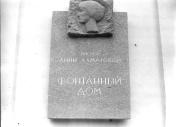
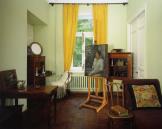
Anna Akhmatova Literary and Memorial Museum
ANNA AKHMATOVA LITERARY AND MEMORIAL MUSEUM, located at 34 Fontanka River Embankment, was opened in 1989 in Fountain House (see Sheremetev Palace) as a branch of the Dostoevsky Literary and Memorial Museum. The museum became independent in 1990. A
|
|
|
|
|
hidden
|
Arctic and Antarctic Institute
ARCTIC AND ANTARCTIC INSTITUTE of the Russian Hydrometeorological Service, situated at 38 Beringa Street. It was founded in 1920 as the Northern Fishery Research Expedition of the Scientific and Technical Department of the All-Russian Council for
|
|
|
|
|
hidden
|
Benois N.L.(1813-1898), architect
Benois Nikolay Leontyevich (1813, St. Petersburg - 1898, at the same place), architect, artist (decorative arts), full State Advisor (1873). Coming from the family of French descendents. He was the farther of Albert N. Benois, L. N. Benois and A. N
|
|
|
|
|
hidden
|
Chevakinsky S. I. (1713-1783), architect
CHEVAKINSKY Savva Ivanovich (1713-1783), architect, representative of the Baroque. From 1729, studied at the Moscow Preparatory School of the St. Petersburg Naval Academy, in 1732-38 apprenticed in architecture with I.K
|
|
|
|
|
hidden
|
Concert Halls (entry)
CONCERT HALLS appeared in St. Petersburg in the late 18th century. Earlier, musicians arranged paid concerts in palaces of grandees, theatres, and taverns. The first documented series of public concerts refers to the concerts given by G
|
|
|
|
|
hidden
|
Eropkin P.M. (about 1698-1740), architect.
EROPKIN Peter Mikhailovich (about 1698-1740, St. Petersburg), architect, urban planner, architecture theorist. In 1716-24 on the order of the Tsar Peter the Great he was trained in Italy, in 1725 he was conferred a title of architect
|
|
|
|
|
hidden
|
Fontanka, river
FONTANKA (known as Bezymyanny Erik until 1712-14), river, a branch in the Neva river delta, which crosses the central part of the city. The river flows from the Neva on the left, beside the Summer Garden
|
|
|
|
|
hidden
|
Free Music School
FREE MUSIC SCHOOL was organised by M. A. Balakirev and G. Y. Lomakin to teach singing and organise concerts. It taught choral classes to adults, singing mainly church music
|
|
|
|
|
hidden
|
Grilles (entry)
GRILLES. St. Petersburg boasts a number of unique metal grilles, created in the course of three centuries. Wrought grilles of bars with (sometimes gilded) decorative figures made from flat iron bars (the grille of the Ekaterininsky (Catherine)
|
|
|
|
|
hidden
|
Museum of Music
MUSEUM OF MUSIC (34 Fontanka River Embankment) is a branch of the Museum of Theatre and Music Art. The Museum of Music is housed in Sheremetev Palace which was given to the museum in 1990
|
|
|
|
|
hidden
|
Public Halls (entry)
PUBLIC HALLS, a special premise for informal mass events. The first public hall was arranged in banker A.A. Ral's house (On the Moika River Embankment, beside Red Bridge; not preserved)
|
|
|
|
|
hidden
|
Punin N.N., (1888-1953), art historian
PUNIN Nikolay Nikolaevich (1888-1953), art theorist, historian, and museum worker. He lived in Pavlovsk and Tsarskoe Selo from the early 1900s. In 1907-14, he studied at the law faculty and faculty of history and philosophy of Petersburg University
|
|
|
|
|
hidden
|
Sheremetev Family
SHEREMETEV FAMILY, noble family, known since the 14th century (in 1706, the senior branch of the family was conferred the title of Counts). Several family members are closely connected with St. Petersburg
|
|
|
|
|
|
hidden
|