The subject index
/
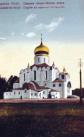
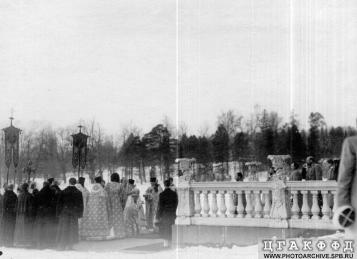
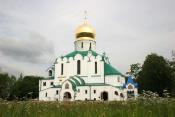
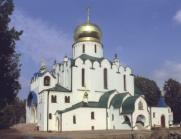
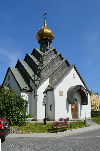
Court Cathedral of Our Lady Feodorovskaya
hidden
|
1909
4 March. On N.S. Gumilyov's initiative I.F. Annensky was acquainted with the critic S.K. Makovsky and the poet M.A. Voloshin in the flat of I.F. Annensky in Sophia Town
|
|
|
Source: Tsarskoe Selo
|
|
hidden
|
1912
11 January. The memorial plaque with the inscription "The Emperor Lyceum Was Placed in This Building from 1811 untill 1843" was opened on the building of the Tsarskoye Selo Lyceum by the 100th anniversary of its founding
|
|
|
Source: Tsarskoe Selo
|
|
hidden
|
1913
Society for the protection of maternity and babies began to work under the management of Professor N.V. Yastrebov in the building of the Maternity Orphanage of Drozhzhina (the present address is 14 Pavlovsky Road)
|
|
|
Source: Tsarskoe Selo
|
|
hidden
|
1915
2 January. The train collision took place at the railway line linked Peterburg and Tsarskoye Selo. Anna Vyrubova, a maid of honour and close friend of the Empress, was seriosly injured at this disaster. A
|
|
|
Source: Tsarskoe Selo
|
|
hidden
|
1992
1 September. 11810 pupils sat down at the desks in nineteen schools of Pushkin Town.
The Chamber of Commerce and Industry was founded in Pushkin Town. The businessman B.L. Blotner was the first president of the Chamber. V.I
|
|
|
Source: Tsarskoe Selo
|
|
hidden
|
1993
The Tsarskoye Selo Art Prize for creative contribution in the Russian culture and arts development was established. Founders of the Prize were the All_Russian Museum of A.S
|
|
|
Source: Tsarskoe Selo
|
|
hidden
|
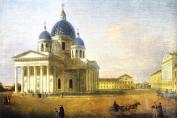
Barracks of the Own His Emperor Majesty Escort
During its random staying in Tsarskoye Selo over the 19th century the Emperor Escort occupied hussar and cuirassier barracks. The first permanent wooden barracks of the Own His Emperor Majesty Escort were built in 1895 in the Alexander Park in
|
|
|
Source: Tsarskoe Selo
|
|
hidden
|
Feodorovsky Settlement (Pushkin Town)
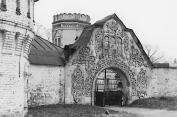
FEODOROVSKY SETTLEMENT, an architectural ensemble of the town of Pushkin, to the north-west from the Alexandrovsky Park. It was constructed in the Neo-Russian style on the initiative of Emperor Nicholas II and encompasses the Court Cathedral of Our
|
|
|
|
|
hidden
|
Krichinsky S. S., (1874-1923), architect
KRICHINSKY Stepan Samoilovich (1874-1923), architect. After graduating from the Civil Engineers' Institute in 1897, he held a post in the Central Directorate for Irregular Duties
|
|
|
|
|
hidden
|
Military Churches (entry)
MILITARY CHURCHES, churches attached to military units, emerged parallelly with the foundation of the city, set up as field churches in regimental settlements - garrison, infantry and guards quarters
|
|
|
|
|
hidden
|
Miracle-Working and Revered Icons (entry)
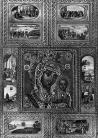
MIRACLE-WORKING AND REVERED ICONS. The most famous Miracle-Working icon of Our Lady of Kazan — the copy of the 16th century of the lost Miracle-Working icon of the same name, can now be seen in the Kazan Cathedral
|
|
|
|
|
hidden
|
Nicholas II, the Emperor (1868-1918)
Nicholas II (1868, Tsarskoe Selo - 1918), Emperor from 1894 to 1917. Son of Emperor Alexander III and Empress Maria Fedorovna. Married Princess of Hesse-Darmstadt, who took the name of Alexandra Fedorovna
|
|
|
|
|
hidden
|
Pokrovsky V.A. (1871-1931), architect
POKROVSKY Vladimir Alexandrovich (1871-1931, Leningrad), an architect, master of the early 20th century neo-Russian style. Graduated from the Academy of Arts (1898; Academician of Architecture since 1907
|
|
|
|
|
hidden
|
Pushkin, town
PUSHKIN, a town and municipal unit situated south of Saint Petersburg. Known until 1918 as Tsarskoe Selo, and in 1918-37 as Detskoe Selo. As of 2002, population totalled approximately 95,000 inhabitants
|
|
|
|
|
hidden
|
Russian Style
RUSSIAN STYLE. A trend in Russian architecture of the 19th - beginning of the 20th century, based on using methods and shapes of ancient and traditional Russian art and architecture. The Russian style emerged out of the aesthetics of Romanticism
|
|
|
|
|
|
hidden
|
|
hidden
|
|
hidden
|
|
hidden
|